Guts to Beat Depression!
Depressive disorders impact approximately 322 million people around the world, affecting every aspect of life, and globally form the leading cause of disability. As such, they contribute to significant morbidity, premature mortality, and economic strain. Despite the availability of effective treatments, the overall burden has not diminished in recent decades. There is worldwide consensus on the need for more sustainable multi-faceted strategies to alleviate both individual distress as well as societal impact.
Emerging research suggests a link between depression and the gut microbiome – the vast and diverse ecosystem of microbes residing in our gut. The gut microbiome's influence on the brain comprises several mechanisms that collectively contribute to the gut-brain axis, a bidirectional communication network between the gastrointestinal tract and the central nervous system (Mayer et al., 2014; Gao et al., 2023). Our cross-sectional pilot studies, which cross-replicated observations from the HELIUS (Healthy Life in an Urban Setting) Study and Rotterdam Study cohorts, established that the association between gut microbiota and depression is notably robust, in terms of both strength and replicability of the associations (Bosch et al., 2022, Radjabzadeh et al., 2022).
The "Guts to Beat Depression!" project aims to identify and validate bacterial targets that can be used for the diagnosis, recovery, or prevention of depression, in a multi-cohort and longitudinal setting with stratification for ethnicity and sex. The full scope and depth of this research requires an interdisciplinary team that combines expertise from microbiomics, psychiatry, epidemiology, neurobiology, and data science. The project was funded by the ZonMw Open Competition 2024 and is a collaboration between Erasmus MC in Rotterdam and UvA and Amsterdam UMC in Amsterdam.

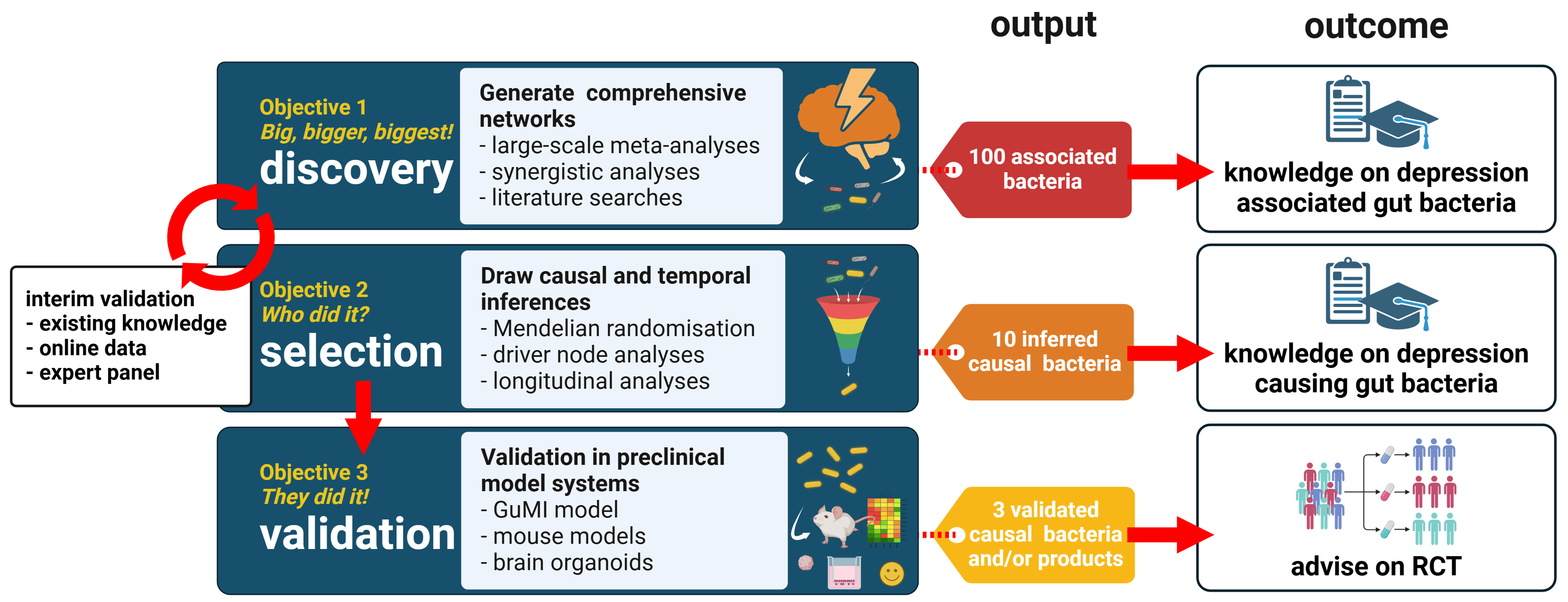
This project will extend the cross-sectional analyses of the pilot studies and aims to determine the temporal and causal nature of depression-microbiome associations in a multi-cohort and longitudinal setting with stratification for ethnicity and sex. Importantly, we also aim to validate promising candidates in an extensive panel of preclinical models. The overall aim of the project is to identify and validate bacterial targets that can be utilised for diagnosis, recovery, or prevention of depression. The project has three key objectives:
- Mayer, E. A., Knight, R., Mazmanian, S. K., Cryan, J. F., & Tillisch, K. (2014). Gut microbes and the brain: paradigm shift in neuroscience. Journal of Neuroscience, 34(46), 15490–15496.
- Gao, M., Wang, J., Liu, P., Tu, H., Zhang, R., Zhang, Y., Sun, N., & Zhang, K. (2023). Gut microbiota composition in depressive disorder: a systematic review, meta-analysis, and meta-regression. Translational Psychiatry, 13(1), 379.
- Bosch, J. A., Nieuwdorp, M., Zwinderman, A. H., Deschasaux, M., Radjabzadeh, D., Kraaij, R., Davids, M., de Rooij, S. R., & Lok, A. (2022). The gut microbiota and depressive symptoms across ethnic groups. Nature Communications, 13(1), 7129.
- Radjabzadeh, D., Bosch, J. A., Uitterlinden, A. G., Zwinderman, A. H., Ikram, M. A., van Meurs, J. B. J., Luik, A. I., Nieuwdorp, M., Lok, A., van Duijn, C. M., Kraaij, R., & Amin, N. (2022). Gut microbiome-wide association study of depressive symptoms. Nature Communications, 13(1), 7128.